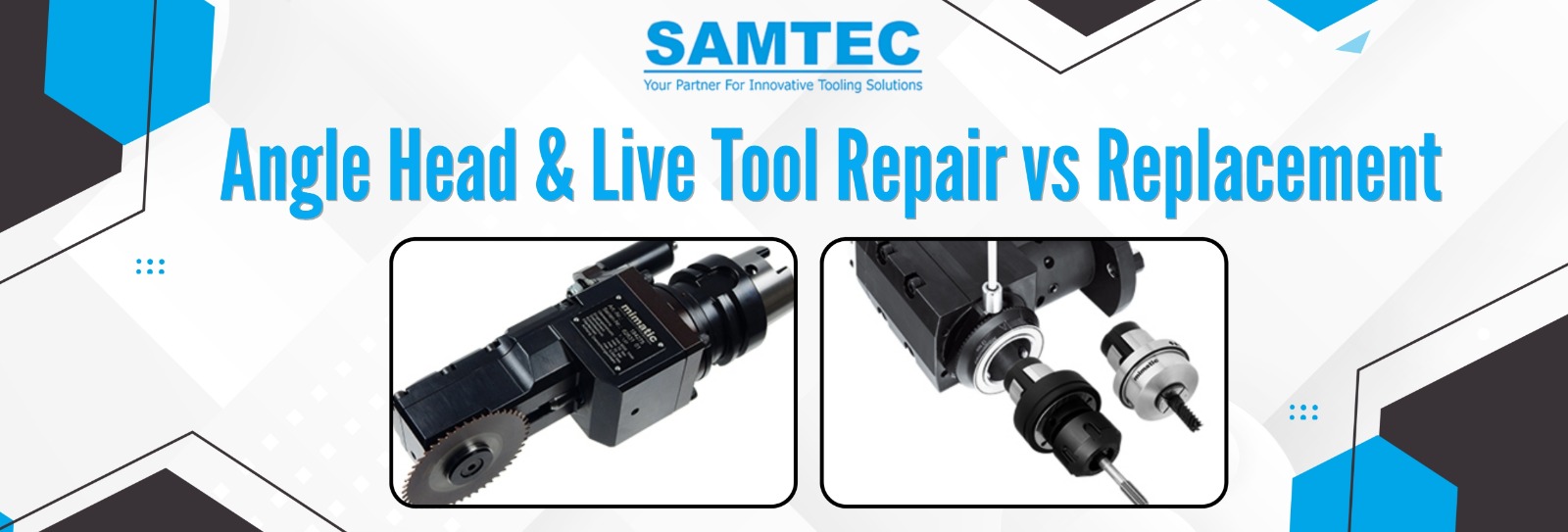
How Smart Repair Saves Cost and Downtime
In today’s fast-paced manufacturing environment, even a short period of machine downtime can disrupt production schedules, delay deliveries, and increase operating costs. Angle heads and live tools are critical components in CNC machining, helping manufacturers achieve complex operations, multi-axis machining, and higher productivity. But when these precision tools fail, one question inevitably arises. Should you repair them or replace them?
While replacement may seem like the simplest option, more manufacturers are now realizing that smart repair and rebuilding can be a far more practical, cost-effective, and sustainable solution. This article explores why repairing angle heads and live tools makes sense, how modern repair practices restore performance, and how expert service providers like Samtec Tools help manufacturers save money and reduce downtime.
Understanding Angle Heads and Live Tools
Angle heads and live tools play an essential role in modern CNC machining. They allow machining at different angles and enable milling, drilling, and tapping operations on CNC lathes without removing or repositioning the workpiece. This flexibility improves accuracy, reduces cycle time, and increases overall productivity.
However, these tools operate under high loads, continuous vibration, and demanding machining conditions. Over time, wear and tear is inevitable. Common problems include bearing wear, spindle runout, damaged gears, lubrication failures, and a noticeable drop in accuracy or surface finish. When these issues arise, quick and informed decision-making becomes crucial.
Repair vs Replacement: Making the Smarter Choice
The Cost of Replacement
Replacing an angle head or live tool often comes with significant drawbacks. New tools require high capital investment and usually involve long procurement and delivery timelines. During this waiting period, machines may remain idle, affecting production schedules and revenue. In many cases, tools that could have been restored are discarded unnecessarily, increasing waste and costs.
The Advantage of Repair and Rebuilding
Professional repair and rebuilding offer a smarter alternative. Repairing a tool typically costs far less than buying a new one, often saving between forty and seventy percent. Turnaround times are usually faster, allowing machines to get back into operation sooner. Most importantly, when done by experienced professionals, repaired tools can deliver performance and accuracy comparable to new tools, extending their service life and improving return on investment.
How Modern Tool Repair Restores Performance
Today’s tool repair is far more advanced than simple part replacement. It is a precise and systematic process designed to restore original performance.
The repair process begins with detailed inspection and diagnosis using advanced techniques such as runout measurement, vibration analysis, and component-level evaluation. This ensures that the real cause of failure is identified and addressed.
Worn or damaged components such as bearings, gears, seals, and shafts are replaced using OEM-grade or equivalent parts. Precision alignment, balancing, and reassembly ensure the tool operates smoothly under machining conditions.
Finally, tools undergo calibration and performance testing to verify accuracy, torque output, and reliability before being returned to production.
Reducing Downtime with Smart Repair
Unplanned downtime is one of the biggest challenges in CNC machining. Waiting for replacement tools can halt production and create costly backlogs. Smart repair helps manufacturers avoid these situations by restoring tools quickly and efficiently.
With timely repair and preventive maintenance, manufacturers can keep machines running, meet delivery commitments, and maintain consistent output quality. Instead of reacting to breakdowns, businesses can adopt a proactive approach that minimizes disruptions.
Repair as a Sustainable and Cost-Efficient Choice
Repairing angle heads and live tools is not only economical but also environmentally responsible. Rebuilding tools reduces material waste and lowers the carbon footprint associated with manufacturing new equipment. As sustainability becomes a growing priority in manufacturing, repair and refurbishment align perfectly with responsible and efficient production practices.
Industry-Wide Demand for Tool Repair Services
Across industries such as automotive manufacturing, aerospace and defense, heavy engineering, and precision tool rooms, demand for repair services is steadily increasing. As CNC machines become more complex and tooling costs rise, manufacturers are shifting toward repair-first strategies to control expenses without compromising performance.
Samtec Tools: Trusted Expertise in Repair and Rebuilding
Samtec Tools is a trusted provider of angle head and live tool repair and rebuilding services, supporting a wide range of CNC machines and tooling brands.
Their dedicated repair facility is equipped with advanced inspection and testing equipment and managed by skilled technicians with deep expertise in CNC tooling systems.
The repair process includes detailed inspection and fault diagnosis, replacement of worn components, precision reassembly and calibration, and final performance testing with documented results. Samtec Tools offers brand-agnostic service, ensuring reliable outcomes for both standard and complex tooling requirements.
By focusing on faster turnaround times and cost-effective solutions, Samtec Tools helps manufacturers reduce downtime, avoid unnecessary replacements, and maintain productivity.
Conclusion
Replacing angle heads and live tools may appear to be the easiest solution, but it often comes with high costs and extended downtime. Smart repair and rebuilding provide a practical, economical, and sustainable alternative that restores performance, extends tool life, and keeps machines running.
With advanced repair technologies and experienced service partners like Samtec Tools, manufacturers no longer have to choose between performance and cost efficiency. Adopting a repair-first approach helps protect investments, maintain machining accuracy, and stay competitive in an increasingly demanding manufacturing landscape.
Why replace when you can repair smarter and keep producing faster?