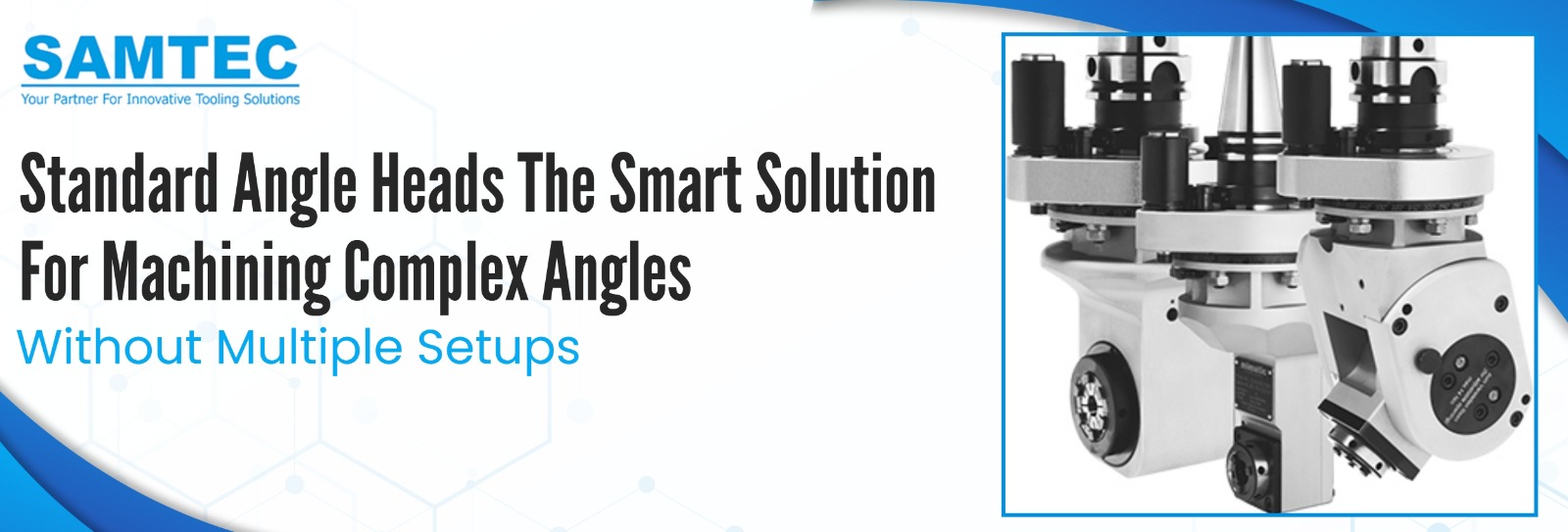
The Smart Solution for Machining Complex Angles Without Multiple Setups
In today’s precision-focused manufacturing world, speed and accuracy matter more than ever. CNC machining projects often involve complex shapes, angled features, and machining on multiple faces of a component. Traditionally, producing these features meant stopping the machine, repositioning the workpiece, or even shifting it to another machine altogether. The result was longer cycle times, a higher risk of errors, and increased production costs.
Standard angle heads offer a smarter and more efficient way to handle these challenges. By allowing machining at different angles in a single setup, they help manufacturers improve accuracy, reduce downtime, and get more out of their existing CNC machines.
What Are Standard Angle Heads?
Standard angle heads are mechanical attachments fitted onto CNC machines to redirect spindle rotation at a fixed angle, most commonly ninety degrees or other predefined angles. This simple yet powerful design allows cutting tools to reach areas that a straight spindle cannot access.
They are widely used for side milling, cross drilling, slotting, back-face machining, and machining angular holes. Because of their versatility, standard angle heads are compatible with machining centers, CNC milling machines, and special-purpose machines across many industries.
Why Multiple Setups Slow Down Production?
Multiple setups may seem unavoidable when machining complex angles, but they create several challenges on the shop floor. Each time a component is unclamped and repositioned, valuable time is lost. There is also a greater chance of alignment errors, which can affect part quality and lead to rework or rejection.
Additional fixtures, increased handling, and longer setup times all add to production costs. Standard angle heads eliminate these issues by allowing machining from different directions while the workpiece remains clamped in a single position.
Key Benefits of Using Standard Angle Heads
One of the biggest advantages of standard angle heads is the reduction in setup time. Multiple operations can be completed without stopping the machine or moving the component, improving overall efficiency.
Accuracy and repeatability also improve significantly. Since the part stays in one position throughout machining, dimensional consistency is maintained, and the risk of misalignment is reduced.
Productivity increases as cycle times become shorter and non-cutting time is minimized. This makes angle heads suitable for both batch production and high-volume manufacturing.
From a cost perspective, angle heads reduce the need for additional machines, complex fixtures, and extra labor. This leads to lower operating costs and a faster return on investment.
Perhaps most importantly, standard CNC machines gain enhanced capability. Manufacturers can perform complex angular machining without investing in expensive multi-axis equipment.
Where Standard Angle Heads Are Used
In automotive manufacturing, angle heads are commonly used for machining engine blocks, transmission housings, and structural components that require side drilling or milling.
Aerospace components often have intricate angular features and tight tolerances. Angle heads help achieve these requirements while maintaining accuracy and reducing setup errors.
In general engineering, job shops and tool rooms rely on angle heads for flexible machining of custom or low-volume parts.
In heavy engineering, where components are large and difficult to reposition, angle heads offer a practical solution by reducing handling and setup effort.
Types of Standard Angle Heads
Standard angle heads come in various designs to suit different machining needs. Fixed ninety-degree angle heads are widely used for common side machining operations. Adjustable angle heads provide flexibility for applications requiring variable angles. High-speed angle heads are ideal for lighter cutting and finishing, while high-torque versions are suited for heavy-duty machining.
Choosing the right angle head depends on the CNC machine interface, spindle type, material being machined, and specific application requirements.
How Angle Heads Improve Productivity
Manufacturers who use standard angle heads often see clear improvements in productivity. Cycle times become shorter, non-cutting time is reduced, and the need for multiple setups and fixtures is eliminated. Part consistency improves, and overall machining efficiency increases.
These benefits make angle heads a preferred choice for companies focused on precision, speed, and cost control.
Maintenance and Long-Term Performance
Like any precision tooling, angle heads require proper care. Regular inspection, correct lubrication, and timely servicing help maintain accuracy and prevent unexpected failures. Professional repair and rebuilding services can restore worn angle heads to near-original performance, extending tool life and reducing replacement costs.
Samtec Tools: Reliable Angle Head Solutions
Samtec Tools offers high-quality standard angle heads designed to deliver precision, durability, and compatibility with leading CNC machines. Their solutions help manufacturers machine complex angles efficiently without the need for multiple setups or expensive machine upgrades.
Samtec Tools supports both standard and application-specific requirements and provides expert service and repair support to help customers maintain productivity and protect their tooling investments.
Conclusion
Machining complex angles no longer has to mean multiple setups, longer cycle times, or higher costs. Standard angle heads provide a smart, efficient, and cost-effective solution for achieving accurate angular machining in a single setup.
By reducing setup time, improving accuracy, and enhancing productivity, angle heads play an essential role in modern CNC machining. With reliable solutions and expert support from Samtec Tools, manufacturers can confidently handle complex machining challenges while maintaining high quality and operational efficiency.